

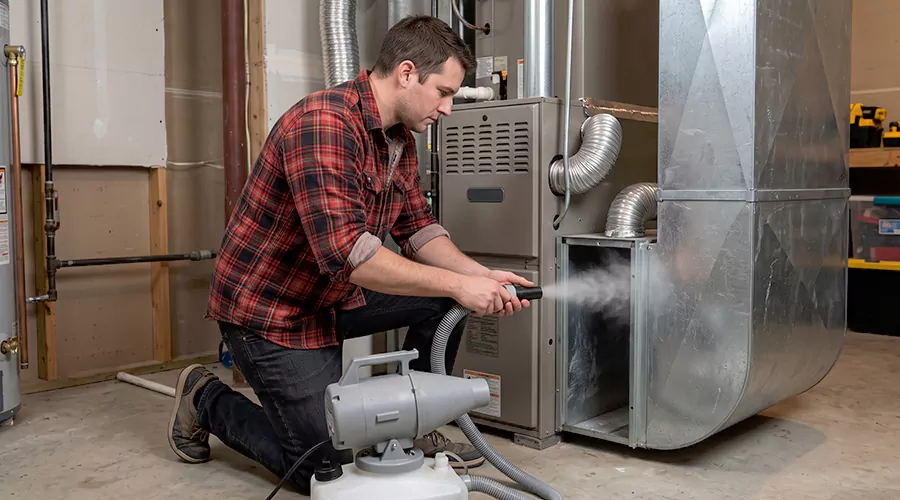
Duct fogging disperses a fine mist or aerosolized product into an HVAC duct system, usually with the intention of treating certain surfaces or controlling odors. Some contractors market it as an antimicrobial treatment, but fogging does not physically remove accumulated dust or debris. Its effectiveness and safety depend on the chemical used, the duct material, the application method, and whether the product is specifically authorized for that HVAC use.
Air ducts carry conditioned air between heating and cooling equipment and occupied rooms. Dust and other particles can gradually accumulate inside these passages. In some situations, moisture or contamination may also affect the ductwork or connected HVAC components.
Duct fogging is sometimes offered alongside professional air duct cleaning. A contractor may describe it as sanitizing, disinfecting, deodorizing, or mold treatment. These terms have different meanings, and the product being applied may not be approved or effective for every advertised purpose.
The Environmental Protection Agency cautions that antimicrobial treatments inside HVAC systems raise questions about effectiveness and possible exposure to building occupants. Fogging should therefore not be viewed as an automatic finishing step for every duct cleaning service.
Understanding what duct fogging does, what it cannot accomplish, and when a professional might propose it helps homeowners make better decisions about treatment.
What Is HVAC Duct Fogging?
HVAC duct fogging is a process in which a liquid product is dispersed as fine droplets into part of an air distribution system. Specialized equipment converts the liquid into a mist or aerosol that can travel through the application area. Depending on the product and method, the droplets may contact portions of the internal duct surfaces.
The purpose varies between services. Some products are intended to leave a scent or control certain odors. Others are marketed for antimicrobial use on suitable surfaces. However, a deodorizing claim is different from a disinfecting claim, and neither automatically means that a product can remove mold or other contamination from the ductwork.
Fogging also differs from cleaning because it does not collect deposited material. Dust and debris can remain inside the ducts after treatment. Physical source removal is still necessary when significant deposits are present.
A product's label determines where and how it can legally be applied. In the United States, antimicrobial products regulated by the EPA must be used consistently with their registered labeling. Permission to use a product on an ordinary hard surface does not automatically permit fogging it into an HVAC system.
How Does Duct Fogging Work?
Duct fogging equipment disperses a liquid into small droplets that travel through the treated area. The droplets may settle on surfaces or remain suspended temporarily, depending on the equipment and product. The intended result depends on the treatment rather than the mist itself.
When an antimicrobial product is involved, the manufacturer may specify surface coverage and a required contact time. Those conditions matter because merely passing a mist through a duct does not establish that the product has contacted every surface adequately. Hidden corners and deposits can interfere with the intended treatment.
The HVAC system's construction also affects distribution. Branches and elbows change airflow paths, while porous internal insulation behaves differently from smooth sheet metal. A treatment that contacts one accessible section may not reach every part of a large duct network.
For this reason, the visible presence of fog at a register does not prove that the full system has been disinfected. It demonstrates that aerosol traveled through part of the passage, not that a verified treatment standard was achieved.
What Are the Main Purposes of Duct Fogging?
Contractors may propose fogging for several different reasons. The intended purpose should be stated clearly because one product may be designed for odor treatment while another carries a specific antimicrobial claim. Some advertised benefits are not supported well enough to be assumed for every HVAC system.
Antimicrobial Surface Treatment
Certain registered antimicrobial products may be used on specific HVAC surfaces when their labels expressly authorize the intended application. These products may have claims related to particular microorganisms under defined conditions. Those claims do not automatically apply to every duct material or application method.
The EPA emphasizes that HVAC systems are a distinct use site because treated surfaces are connected to air moving through occupied buildings. A product labeled for sanitizing a countertop is not automatically approved for fogging into ducts. Both the HVAC use and application directions must be checked.
Even an authorized antimicrobial treatment is not a substitute for removing significant deposits or correcting moisture problems. It should be considered only in circumstances supported by inspection and appropriate product labeling.
Odor Treatment
Some fogging services use products intended to reduce or mask certain odors. A scented treatment may change the smell of air temporarily without removing the source of the odor. This distinction matters when the odor originates from damp insulation or a drainage problem.
For example, a musty smell may come from water remaining near the cooling coil or condensate pan. Fogging the ducts does not repair the drainage system or dry damaged building materials. A recurring odor requires investigation rather than repeated fragrance treatment.
The proposed product should be identified before application. Homeowners should know whether the contractor intends to mask an odor or address a documented contaminant.
Post-Contamination Treatment
Fogging may be proposed after physical cleanup of a particular contamination problem. Whether this is appropriate depends on the material and the approved product instructions. It should not be assumed necessary for every cleanup.
For example, a contractor may propose an antimicrobial treatment after cleaning a suitable hard-surface duct. The product must be labeled for that HVAC surface and method of application. The work should also address the original moisture or contamination source.
Contamination affecting porous materials can present a different problem. Wet or moldy fiberglass duct insulation generally requires replacement rather than fogging. Applying chemicals over contaminated insulation does not restore its condition.
Does Duct Fogging Remove Dust and Debris?
No. Duct fogging does not remove accumulated dust, pet hair, construction debris, or other solid deposits from the air distribution system. A mist may contact some particles, but it does not collect them or transport them into a controlled waste container. Material left inside the duct can remain there after treatment.
Professional source-removal cleaning uses suitable brushes or air agitation tools together with vacuum collection equipment. The purpose is to loosen deposited material and remove it from the system. Fogging and physical cleaning therefore perform different tasks.
| Problem | Does Fogging Fix It? | More Appropriate Response |
|---|---|---|
| Loose dust inside ducts | No | Physical cleaning when justified |
| Thick construction debris | No | Controlled debris removal |
| Disconnected duct joint | No | Mechanical repair and sealing |
| Wet fiberglass insulation | No | Correct water source and evaluate replacement |
| Damaged condensate drain | No | Drainage repair |
| Musty odor from damp materials | Does not correct the cause | Identify and resolve moisture |
| Approved treatment of a suitable surface | Possibly, under specific conditions | Verify product label and application |
| Dusty return grille | Not needed | Household surface cleaning |
This distinction prevents homeowners from paying for fogging when the actual need is cleaning or repair. A duct containing significant visible debris should not be treated with a chemical simply to avoid removing the material.
Does Duct Fogging Kill Mold?
Duct fogging should not be assumed to eliminate mold inside an HVAC system. The result depends on the product and whether the label authorizes the application. The material being treated and the amount of contamination also influence whether treatment is appropriate.
The EPA advises that visible mold contamination should first be assessed and the moisture source corrected. Mold can return when the conditions supporting its growth remain present. Applying an antimicrobial product without correcting water intrusion or condensation does not solve the underlying problem.
Bare sheet metal and fiberglass-lined ducts require different approaches. Some treatments may be authorized for certain unlined metal surfaces, but the EPA states that no antimicrobial products are registered as biocides for internally insulated fiberglass duct systems. The product's current registered labeling should always be verified before use.
Wet or moldy fiberglass duct material generally needs replacement because cleaning may not restore the contaminated porous surface. This includes certain flexible duct and duct board installations. Spraying or fogging the material should not be presented as an equivalent alternative.
A musty odor or dark stain alone does not prove that mold is present. When identification matters, an appropriate inspection should establish the condition before treatment is selected.
Does Duct Fogging Improve Indoor Air Quality?
There is no reliable basis for claiming that routine duct fogging improves indoor air quality in every home. The potential result depends on whether a specific contaminant is present and whether the proposed treatment addresses it safely. Applying an unnecessary chemical can also introduce new substances into the air distribution system.
The EPA notes that research has not demonstrated the general effectiveness of most chemical biocides used inside ducts or fully established their potential adverse health effects in that setting. A fogging treatment should therefore not be advertised as a guaranteed method for creating healthier indoor air.
Indoor air quality depends on several factors beyond the ducts. Appropriate filtration and moisture control can play important roles, along with reducing actual pollutant sources. Duct fogging cannot replace these measures.
Homeowners should be cautious of claims that one treatment removes all allergens, kills every microorganism, or permanently prevents future contamination. Such promises are broader than what the presence of a fogging machine or chemical label alone can establish.
Is Duct Fogging Safe?
The safety of duct fogging depends on the product, application method, and potential exposure to occupants. Aerosolized chemicals can move through an HVAC system and may enter occupied spaces. Some people may experience irritation or other reactions to particular products.
An EPA registration number on a product does not automatically make every application safe or legal. The specific registered label must authorize the intended HVAC use and method. A product approved for wiping a hard surface may not be approved for airborne fogging.
The duct system also needs to be evaluated before treatment. Damaged connections or unusual duct materials can change where droplets travel and whether surfaces can be treated appropriately. The contractor should account for the complete system rather than apply the same method to every home.
Occupants should not be expected to remain in the treatment area unless the product's labeling and the professional application plan permit it. Reentry, ventilation, and equipment restart instructions must follow the actual product requirements, not a generic waiting time.
What Is the Difference Between Duct Fogging and Duct Cleaning?
Duct cleaning physically removes appropriate dust and debris. Duct fogging introduces a product into the system for a separate intended purpose. The two methods should not be described as interchangeable.
| Feature | Air Duct Cleaning | Duct Fogging |
|---|---|---|
| Main purpose | Remove deposited debris | Apply a fine mist or treatment |
| Dust removal | Yes, when performed properly | No |
| Main equipment | Brushes, agitation tools, vacuum collection | Suitable fogging or aerosol equipment |
| Routine chemical application | Not necessary | Involves an applied product |
| Mold-related work | Requires assessment and material-specific removal | Limited by approved product use |
| Repairs water damage | No | No |
| Repairs air leaks | No | No |
| Need determined by | Actual contamination | Specific justified treatment and labeling |
Fogging should not be used to make an incomplete cleaning appear more thorough. If ducts contain significant deposits, source removal is the method intended to collect those materials. Any additional treatment should have a separate and documented reason.
What Is the Difference Between Fogging, Sanitizing, and Disinfecting?
These terms are sometimes used together in advertising, but they describe different concepts. Fogging refers to how a product is dispersed. Sanitizing and disinfecting refer to specific antimicrobial claims that require supporting product registration and labeling where regulated.
A fogging machine does not automatically provide disinfection. The droplets may not reach every surface, and the required product contact conditions may not be achieved. The treatment's claimed effect must be supported by the product label and authorized application method.
Deodorizing is different again. A deodorizer may reduce or cover a smell without addressing microorganisms or removing debris. A homeowner should ask the contractor to explain which of these results is actually intended.
Ozone treatment is also not the same as ordinary duct fogging. Ozone is a lung irritant, and the EPA warns about its use for controlling indoor biological contaminants. It should not be presented as a routine safe alternative to physical duct cleaning.
When Might a Contractor Recommend Duct Fogging?
A contractor may propose fogging after identifying a specific condition and selecting a product authorized for the relevant HVAC surfaces. However, a recommendation should be supported by the actual inspection rather than treated as a standard addition to every duct cleaning appointment.
Before accepting the service, homeowners should request evidence of the problem. A contractor claiming microbial contamination should explain how it was identified and why physical cleaning or moisture correction alone is insufficient. The proposed product and method must also be suitable for the duct material.
The EPA recommends using caution when evaluating chemical treatments inside HVAC systems. A professional should be willing to explain the benefits and limitations without promising permanent sterilization or guaranteed health improvements.
What Happens During a Professional Duct Fogging Service?
A responsible treatment process begins with inspection and confirmation that the proposed product is appropriate. The exact application steps must follow the specific product label and equipment instructions. There is no universal fogging procedure that is safe or permitted for every HVAC system.
Step 1. Inspect the Ductwork
The contractor identifies the duct materials and assesses any visible contamination. The inspection should include consideration of moisture and damaged connections. A treatment should not proceed when important conditions remain unknown.
Fiberglass-lined ducts require particular attention because an antimicrobial product suitable for bare metal may not be authorized for porous materials. The system may contain several duct types, so one approved surface does not establish that every branch can be treated.
Step 2. Identify the Reason for Treatment
The contractor should explain which condition the fogging is intended to address. Ordinary dust is not a sufficient reason for an antimicrobial treatment. If mold is suspected, the extent and moisture source need evaluation before a cleanup method is selected.
Any physical cleaning or repair required to address the condition should be identified. A duct with significant debris needs source removal, while wet insulation may require replacement. Chemical application should not take the place of these tasks.
Step 3. Verify the Product Label
The proposed product should be identified by name and its applicable registration details. The contractor must confirm that the actual label permits use in the specific HVAC setting and by the proposed application method. General hard-surface instructions are not enough when HVAC use is not authorized.
The label also provides directions for application and any restrictions involving occupants or equipment. These instructions take precedence over generic advice about fogging. The contractor should be able to provide the labeling information before work begins.
Step 4. Complete Necessary Cleaning or Repairs
When significant deposits exist, suitable physical cleaning should be performed before considering treatment. Moisture problems must also be corrected. Applying a product over dirt or wet insulation does not produce the same result as removing the underlying problem.
Any damaged duct connection should be repaired because it may allow treatment material to escape into unintended locations. The system should be in appropriate mechanical condition before application.
Step 5. Apply Only as Authorized
If the treatment remains justified and permitted, qualified personnel follow the product-specific application instructions. This includes any requirements for equipment, surface preparation, exposure control, and contact time. The method must not be improvised from instructions intended for ordinary household spraying.
The contractor should protect occupants and prevent unauthorized exposure. Any required restrictions on occupancy or ventilation should be communicated before the work begins.
Step 6. Follow Reentry and Restart Instructions
The HVAC equipment should return to service only as permitted by the product's directions. Any required ventilation or reentry conditions must be satisfied. There is no universal waiting period that applies to every fogging treatment.
The contractor should document the product used and the work performed. The homeowner should also receive any relevant aftercare instructions. A professional service should end with a clear explanation of what the treatment was intended to accomplish.
What Are the Risks and Limitations of Duct Fogging?
Duct fogging has limitations because the treatment may not reach every surface evenly. Debris and porous materials can affect contact with the chemical. The product may also travel into occupied areas if the application is not properly controlled.
Important concerns include:
- Aerosolized chemicals may reach areas beyond the intended treatment surface.
- A product may not be labeled for use inside HVAC ducts.
- Fogging may not create the required contact time for antimicrobial claims.
- Heavy dust remains inside ducts unless physically removed.
- Moisture problems can allow contamination to recur.
- Porous internal insulation may be unsuitable for treatment.
- Some occupants may be sensitive to chemical residues or odors.
- An unapproved product can create legal and safety concerns.
- Fragrance may hide an odor without removing its source.
- Treatment can be sold unnecessarily as part of a standard cleaning package.
These concerns do not mean every authorized surface treatment is inappropriate. They mean that treatment requires a specific reason and suitable product use. The method should be selected from the actual inspection findings.
Can You Fog Air Ducts Yourself?
DIY duct fogging is not recommended as a routine home maintenance task. Selecting a chemical involves more than choosing a product advertised as a disinfectant. Its labeling must specifically authorize the HVAC application and method.
An ordinary household fogger may disperse material through the system without controlling where it settles. Electrical equipment and internal insulation may also be exposed to products that are unsuitable for them. The homeowner may not have a reliable way to verify the result.
If ordinary dust is the concern, clean accessible vent covers and maintain the HVAC filter. When significant internal contamination is suspected, arrange inspection rather than introducing chemicals into the ductwork.
What Should You Ask Before Paying for Duct Fogging?
A contractor should explain the proposed treatment in a way that distinguishes it from cleaning. The homeowner should understand what problem is being addressed and which surfaces will receive the product. A vague claim that fogging is needed to freshen every HVAC system is not enough.
Ask these questions:
- What specific problem was found during inspection?
- Is the treatment intended to sanitize, disinfect, or control odor?
- What product will be used?
- Does its registered label authorize this HVAC application and method?
- Are the ducts bare metal, flexible, or internally insulated?
- Will physical cleaning or moisture repair be completed first?
- How will occupants and pets be protected?
- What reentry and equipment restart instructions apply?
- What results can realistically be expected?
- Is the treatment optional or supported by a documented need?
A trustworthy provider should be comfortable discussing product limitations. If the contractor cannot provide the label or explain why fogging is necessary, the treatment should not be approved.
How Can You Prevent Duct Contamination Without Fogging?
The most effective long-term measures involve keeping dust and moisture from entering the HVAC system. Proper filtration reduces particles moving through the return path, while sound duct connections prevent unwanted air from being drawn from dusty spaces. These steps address the source instead of treating deposits after they accumulate.
Check filters regularly and replace them according to the equipment manufacturer's instructions. Repair return duct leaks and keep the cooling condensate system draining properly. Water-damaged insulation should be evaluated promptly.
During renovations, protect duct openings from construction debris. Clean visible grilles as part of household maintenance, and investigate significant internal contamination when evidence appears. None of these tasks requires automatic chemical fogging.
Conclusion
Duct fogging distributes a fine mist into an HVAC system for a particular treatment purpose. It does not remove dust or repair damaged ductwork, and it should not be assumed to eliminate mold. Antimicrobial products must be appropriate for the duct material and specifically authorized for the proposed HVAC use. Physical cleaning and correction of moisture problems remain important when contamination is present. Before approving fogging, request the product label and a clear explanation of why the treatment is needed.